
State what is being replaced
Identify the incumbent polymer and keep its function separate from alum coagulation. A request for an alternate aid should not silently become a coagulant replacement or an instruction to eliminate one treatment stage.
The treatment-role guide anchors the comparison. Ask whether the supplier proposes a functionally similar flocculant or a materially different program and identify the additional evidence needed.
Retain the alum and water conditions
Record alum identity and assay basis, calibrated addition, alkalinity, final pH and correction. Include temperature, turbidity or solids and relevant source variability. An alternate aid must be judged against a meaningful current-program reference.
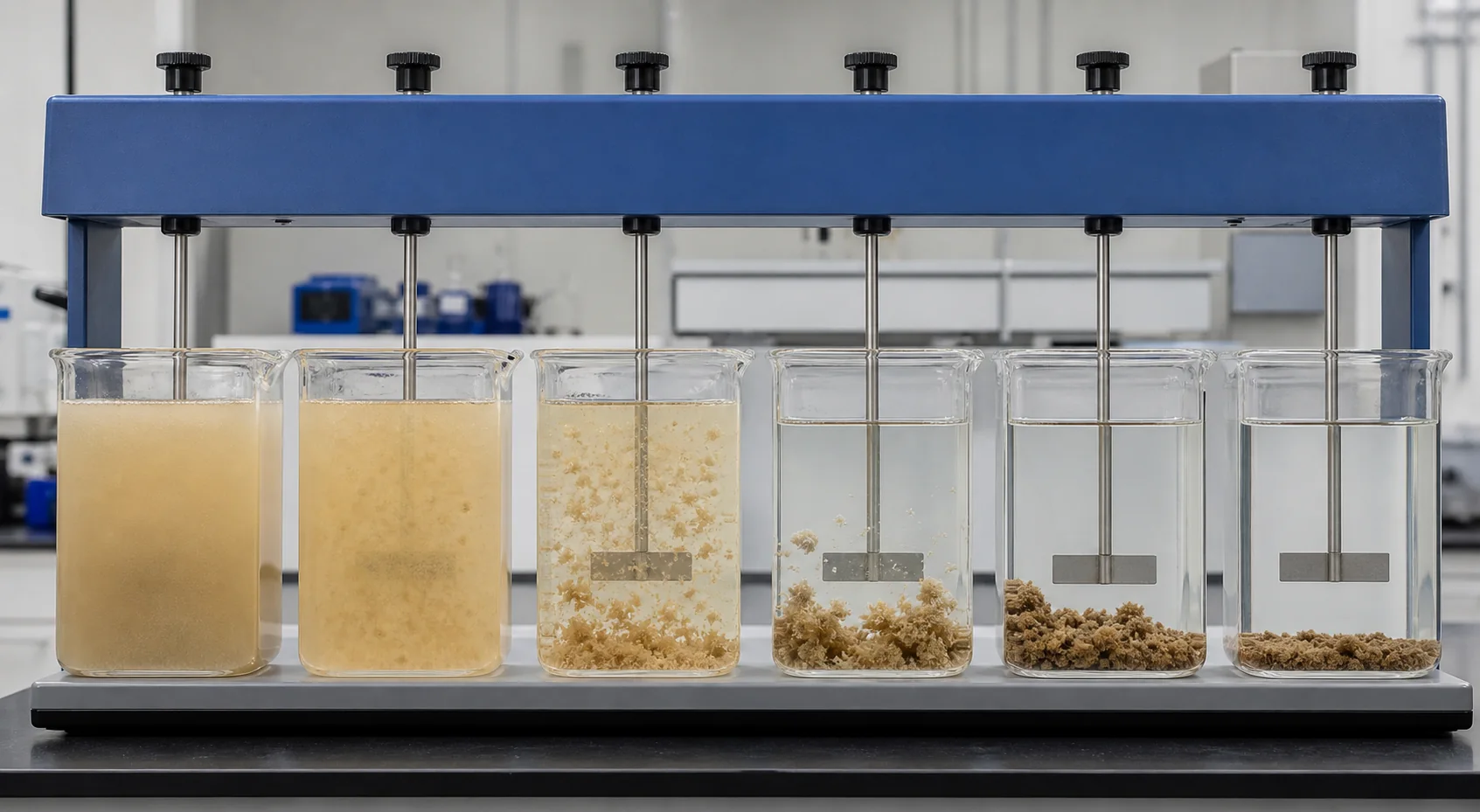
Keep alum conditions fixed for an aid-only comparison. If the trial changes both chemicals, use a deliberate matrix and preserve coagulant-only controls rather than attribute the combined response entirely to the new polymer.
Compare realistic preparation
Use the actual powder or emulsion procedure, water and residence available at the plant. Record stock concentration, age and transfer history. A fully developed laboratory stock may hide a make-down constraint.
Keep supplied-product and active additions explicit and verify metering. Differences in preparation or pump output should not be treated as evidence of a superior molecular or ionic profile.
Match the hydraulic opportunity
Map alum dispersion, polymer addition, flocculation stages and transfer to the clarifier. Confirm that the candidate's useful response develops within the available contact time and survives the relevant shear.
The mixing sequence review helps locate these constraints. An aid that performs only after extra gentle laboratory time is not necessarily suitable for a short plant train.
Protect filtration and solids handling
Measure settled-water quality, carryover and relevant sludge and filter outcomes. A larger or faster-settling floc can still create poor filterability or fragile carryover after transfer. Define reading times and methods in advance.
For potable use, product eligibility is a separate gate owned by the utility. Do not infer that a polymer is approved because alum is already accepted or because the aid works at a low measured addition.
Use a controlled changeover plan
Keep trial material segregated, verify feed calibration and name the authorized reviewer. Preserve the incumbent reference and specify conditions for an inconclusive result or a return to the previous program.
Record water and load changes during the trial. A short improvement during an easier raw-water interval cannot establish permanent dose savings or a robust alternate supply position.
Connect approval to procurement
Retain the accepted grade, form, active definition, preparation, water envelope and separator results. Compare scoped delivered cost at measured consumption and list any additional handling or correction needs.
Use the alum-program polymer enquiry to provide the existing treatment data and trial scope. Request an identifiable replacement candidate rather than an unrestricted claim that one aid suits every alum system.
Write the replacement boundary explicitly
Summarize the accepted alum baseline, source-water range, alternate polymer identity, preparation and separator measurements in a crossover record. Mark any restriction on temperature, feed capacity or downstream filtration that limited the trial.
Keep the incumbent's evidence and fallback conditions available to operations. A backup accepted in a defined range can be commercially useful without being described as an exact universal substitute. The order should preserve those restrictions so a later supply interruption does not become automatic authorization for an untested use.